The sky-watcher heritage 150p rv tabletop setup is one of the smartest portable astronomy choices for 2026 road-trippers who want serious aperture without hauling a tripod tower. This 6-inch collapsible Dobsonian collapses to about 18 inches long, weighs roughly 14 pounds, and sits flat on any RV picnic table or campsite bench. Within sixty seconds you can extend the truss tube, drop in a 25mm eyepiece, and be scanning Jupiter, the Orion Nebula, or the Andromeda Galaxy—no batteries, no alignment routine, no tripod legs sinking into gravel. For RVers chasing dark skies from Big Bend to Cherry Springs, this is the rare scope that earns its cargo-bay slot.
Why the Heritage 150P Excels on RV Picnic Tables
Picnic tables at RV parks and boondocking pull-outs are a specific environment: they are usually slightly warped, often at slightly the wrong height for a standing observer, and always covered in pine sap, pollen, or breakfast crumbs by morning. The Heritage 150P answers these constraints in a way that traditional refractors and Schmidt-Cassegrain tripod scopes simply cannot.
The best sky-watcher heritage 150p rv tabletop for your situation depends on how you plan to use it and where.
The base is a circular rocker box about 14 inches across, with three rubber feet that grip wood-plank tables without rocking. Because the scope pivots in altitude on the rocker rather than on a centered tripod head, the center of gravity stays well inside the table's footprint even when you swing toward the horizon. There is no leg-spread fight with the bench seat, no tripod foot dangling off a knot in the wood, and no danger of a cat-five gust folding a tripod when a desert squall rolls through camp.
The collapsible truss design is the other half of the story. Compressed, the optical tube assembly stows in a cabinet next to your camp chairs. Extended, you get the full 750mm focal length and the light grasp of a true six-inch primary mirror—enough aperture to resolve the Cassini Division in Saturn's rings, split tight double stars, and pull faint galaxy detail out of Bortle 3 skies. RV travelers who already invested in a dark-sky park membership get to actually use those dark skies, instead of squinting at smudges through a 70mm achromat.
Key Specs at a Glance
- Aperture: 150mm (5.9 inches) parabolic primary mirror
- Focal length: 750mm, f/5
- Collapsed length: approximately 18 inches
- Extended length: approximately 28 inches
- Total weight: approximately 14 pounds (OTA plus base)
- Mount type: manual Dobsonian alt-azimuth on rocker box
- Focuser: 1.25-inch helical / rack-and-pinion (model dependent)
- Finder: red-dot reflex sight
- Included eyepieces: typically 25mm and 10mm Plossl
That f/5 focal ratio is fast enough for wide-field views of the Milky Way star clouds you came camping for, but slow enough that decent eyepieces still perform without exotic coma correctors. The combination of aperture and portability is the Heritage 150P's whole pitch, and it is genuinely hard to beat in the under-$500 category.
Sky-Watcher Heritage 150P vs. Computerized RV Alternatives
Some RVers do not want to star-hop manually after a long day driving I-40. For those travelers, a battery-powered GoTo scope makes more sense, even though it sacrifices the picnic-table-and-go simplicity that defines the Heritage. The table below compares the manual 150P against the two most common computerized SCT alternatives that still fit in an RV basement bay.
| Spec | Sky-Watcher Heritage 150P | Celestron NexStar 6SE | Celestron NexStar 8SE |
|---|---|---|---|
| Aperture | 150mm (5.9 in) | 150mm (6 in) | 203mm (8 in) |
| Optical design | Newtonian reflector | Schmidt-Cassegrain | Schmidt-Cassegrain |
| Focal length | 750mm (f/5) | 1500mm (f/10) | 2032mm (f/10) |
| GoTo / tracking | Manual only | Computerized GoTo | Computerized GoTo |
| Setup time | ~60 seconds | ~10 minutes (alignment) | ~10 minutes (alignment) |
| Total weight | ~14 lb | ~30 lb | ~33 lb |
| Power needed | None | 12V (battery or shore) | 12V (battery or shore) |
| Best use | Quick picnic-table sessions | Tracked planetary imaging | Deep-sky GoTo tours |
The right choice depends on whether you treat astronomy as a five-minute campsite ritual or a two-hour planned session. If shore power is reliable and you have time to align, the Celestron options unlock object databases the Heritage cannot match. If you're cooking dinner over a fire and want to glance at Saturn between courses, the 150P wins.
Computerized Alternatives Worth Considering
Celestron NexStar 6SE — The Tracked Six-Inch Option
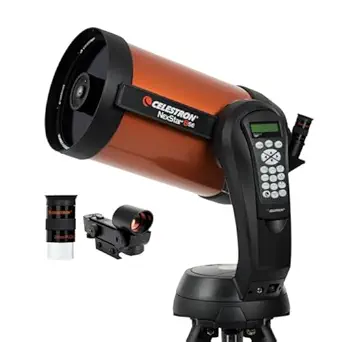
The NexStar 6SE matches the Heritage 150P on aperture but adds motorized tracking and a 40,000-object database driven by Celestron's SkyAlign routine. For RVers who want to keep Jupiter centered while passing the eyepiece around the picnic table to four kids and a curious neighbor, the tracking alone justifies the price. The single-fork arm mount packs into the included carry box and tucks beside a Class B's wet bay. The f/10 focal ratio is long enough that high-power lunar views look stunningly contrasty, and short enough that the entire Veil Nebula complex fits in a wide-field eyepiece. Power off your house battery via a 12V cigarette adapter and you'll get a full evening's GoTo time. View the Celestron NexStar 6SE on Amazon.
Celestron NexStar 8SE — Maximum Aperture That Still Fits in an RV Basement
If you have the basement space and a stable picnic table, the eight-inch NexStar 8SE is the deep-sky upgrade. The extra 53mm of aperture over the Heritage 150P pulls roughly 1.8 times more light, which translates to visibly brighter galaxy cores, more globular cluster resolution, and crisp views of Mars surface features when the planet is well-placed in 2026. The single-arm fork mount is the same form factor as the 6SE, so setup remains a one-person operation. Total weight is about 33 pounds split between tube and mount, which most fifth-wheel and Class A travelers handle without complaint. Check current pricing on the NexStar 8SE.
Celestron NexStar 8SE with Eyepiece and Filter Kit — Best Value Bundle
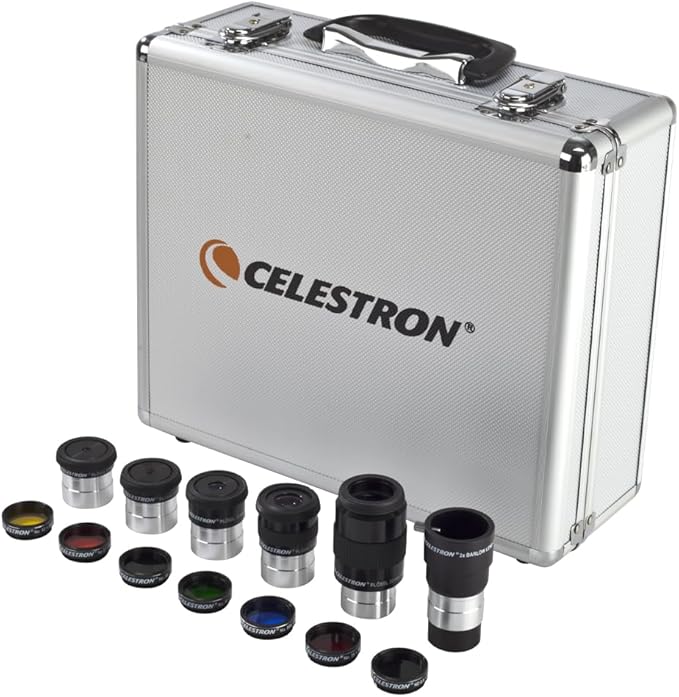
For travelers who don't already own a quality eyepiece case, the bundle version of the 8SE includes additional 1.25-inch eyepieces, color planetary filters, and a moon filter in a foam-lined carry case. Buying the kit at the same time as the scope tends to save 20 to 30 percent versus piecing the same accessories together later, and the case itself is rugged enough to ride in an unsecured cabinet without damaging the optics. For an RV setup where storage organization matters as much as optical performance, this bundle solves both at once. See the NexStar 8SE eyepiece kit bundle.
Setup Tips for RV Picnic-Table Observing
A few practical habits make the Heritage 150P shine in a campsite context. First, wipe the picnic table dry before placing the base; condensation on rough wood will wick into the rocker box's particleboard over multiple nights. A cheap silicone baking mat under the base solves this permanently and also dampens vibration when someone walks past. Second, give the optics 20 to 30 minutes of cool-down time after pulling the scope from a hot RV interior—desert daytime cabin temperatures of 95°F-plus will produce shimmering thermal currents inside the tube until the mirror equilibrates with night air.
Third, watch your finder. The Heritage's red-dot sight runs on a small lithium coin cell that drains if the switch gets bumped during transit. Keep two spare CR2032 batteries in your eyepiece case and check the dot before sunset, not after the stars come out. Finally, deploy a simple red-flashlight headlamp at the table; campsite neighbors will appreciate it, and your dark adaptation will hold for the entire session.
For collimation, the 150P's truss design means the secondary can shift slightly during transport. A laser collimator that fits a 1.25-inch focuser takes 90 seconds to use and lives in any glove compartment. Check our companion guide on collimating flex-tube Newtonians on the road for a step-by-step routine designed around RV vibration.
Eyepiece and Accessory Recommendations
The Heritage 150P ships with two Plossl eyepieces that are perfectly serviceable, but two upgrades transform the experience. A 32mm wide-field eyepiece drops the magnification to about 23x and turns the scope into a star-cluster sweeper that frames the Pleiades, the Beehive, and the double cluster in Perseus with room to spare. At the other end, a quality 6mm or 7mm eyepiece pushes the scope to about 110-125x for planetary detail, which is roughly the practical maximum on a typical picnic-table night with average atmospheric seeing.
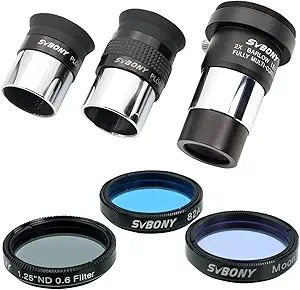
A 2x Barlow doubles your eyepiece collection's range and costs less than a tank of diesel. A UHC nebula filter brings out the Veil and North America Nebula details that the Heritage's aperture can reveal under genuinely dark RV-park skies. For storage, a small Pelican-style case with custom foam protects all of this inside the RV during travel.
If you're still planning your campsite itinerary, our roundup of 2026 dark-sky-certified RV parks across North America pairs perfectly with this scope.
Frequently Asked Questions
Can the Sky-Watcher Heritage 150P really sit on a standard RV picnic table without tipping?
Yes. The rocker base footprint is about 14 inches in diameter, well within a standard 28-inch wide picnic-table top. The center of gravity stays low because the primary mirror is at the bottom of the tube, and the three rubber feet grip rough lumber surprisingly well. The only failure mode is severe wind above roughly 15 mph, in which case you should observe from a windbreak or fold up and try again the next night.
How does the Heritage 150P compare to the smaller Heritage 130P for RV use?
The 130P is lighter (about 8 pounds versus 14) and packs even smaller, but you lose noticeable aperture. For an RV with truly limited basement space—a teardrop trailer or van conversion—the 130P may be the smarter choice. If you have the cargo room for a 14-pound scope and a 28-inch tube extended, the 150P delivers a meaningfully brighter view of every deep-sky target without making setup harder.
Do I need to collimate after every RV travel day?
Not usually. A quick laser check before each observing session takes 90 seconds and tells you whether anything shifted. In our testing, the truss tube design typically holds collimation across moderate driving distances on paved highways. Washboard forest roads and heavy off-road washes are the conditions where you should expect to re-collimate the secondary on arrival.
Will the Heritage 150P work as a solar telescope for daytime RV observing?
Only with a properly fitted, full-aperture white-light solar filter from a reputable manufacturer such as Baader or Thousand Oaks. Never point the scope at the sun without one—the f/5 focal ratio concentrates enough heat to damage eyepieces and eyes within seconds. With a proper filter, the 150mm aperture resolves sunspot detail and granulation beautifully during daytime stops.
Can I attach a smartphone or camera for astrophotography from a picnic table?
Casual lunar and planetary snapshots through a smartphone adapter work fine on a manual Dobsonian, though you'll be chasing the target as Earth rotates. For tracked astrophotography, you really want a computerized GoTo mount like the NexStar 6SE or 8SE—the Heritage 150P is fundamentally a visual scope. See our complete RV astronomy gear guide for camera adapter recommendations that work with both styles.
What's the lowest temperature the Heritage 150P will tolerate at a winter RV site?
The mechanics handle subfreezing temperatures fine; the practical limits are your own comfort and the dew point. Below about 25°F, focuser grease stiffens slightly but still works. Dew is the real enemy on cold clear nights—a simple 12V dew strap or even a hair-dryer pass every 30 minutes keeps the primary mirror clear. Store the scope inside the RV after use so internal frost doesn't condense on the optics.
Is the Heritage 150P a better RV choice than a computerized scope for beginners?
For most beginners, yes. The Heritage teaches you the sky because you have to find objects yourself, which is a skill that pays off forever. It also has no batteries, no firmware, no alignment failures at 2 AM, and no hand controller to misplace at a fuel stop. Computerized scopes are wonderful tools, but they reward observers who already know what they're hunting. If you're new to astronomy and new to RV life simultaneously, the simplicity of the manual Dobsonian is a feature, not a limitation. Compare it head-to-head against other tabletop options in our best tabletop Dobsonians of 2026 roundup.
Key Takeaways
- Choosing the right sky-watcher heritage 150p rv tabletop means matching capacity and output ports to your actual devices
- Always check actual watt-hours (Wh), not just watts — runtime depends on Wh, not peak output
- Also covers: heritage 150p picnic table mount
- Also covers: rv camping tabletop dobsonian
- Also covers: heritage 150p road trip astronomy
- Compare price-per-Wh across models to find the best value for your budget