json
If you've been researching computerized telescopes in the $1,200–$1,600 price range, the Celestron NexStar 8SE has almost certainly appeared at the top of every list. It's been the benchmark Schmidt-Cassegrain telescope (SCT) for intermediate and advancing amateur astronomers for years — and in 2026, it still earns that reputation. But "benchmark" doesn't mean "right for everyone." This guide is written for the observer who has moved past the entry-level stage and wants to know, in concrete terms, what the NexStar 8SE actually delivers, where it falls short, and how it stacks up against real alternatives costing similar money.
By the time you finish reading, you'll know the optical specs that matter, the mount's real-world GoTo accuracy, what astrophotography you can and cannot reasonably attempt, and exactly which type of observer will — or won't — get maximum value from spending roughly $1,350–$1,500 on this telescope.
NexStar 8SE Quick-Reference Specs
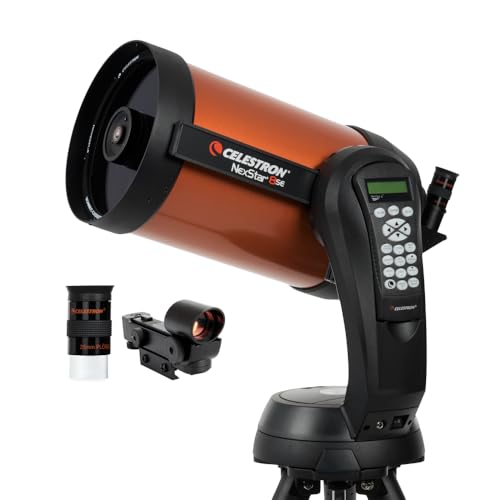
- ADVANCED TECH MEETS ICONIC DESIGN: The NexStar 8SE pairs Celestron’s legendary orange tube with a fully computerized GoTo system—ideal for those ready to step up from manual
- 8-INCH SCHMIDT-CASSEGRAIN OPTICS: The large 8" aperture gathers enough light to reveal fine lunar details, cloud bands on Jupiter, and deep-sky objects like galaxies and globular
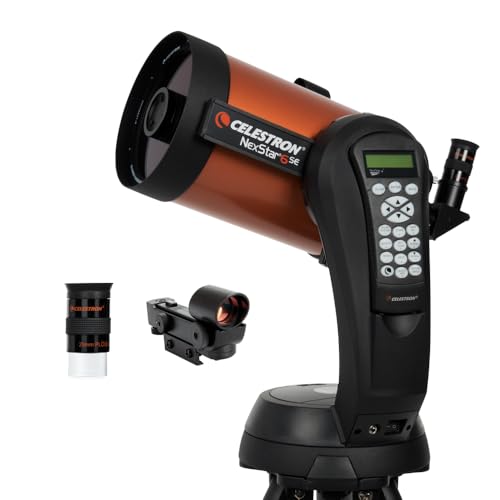
- ADVANCED TECH MEETS ICONIC DESIGN: The NexStar 6SE pairs Celestron’s legendary orange tube with a fully computerized GoTo system—ideal for those ready to step up from manual
- 6-INCH SCHMIDT-CASSEGRAIN OPTICS: The large 6" aperture gathers enough light to reveal fine lunar details, cloud bands on Jupiter, and deep-sky objects like galaxies and globular
Top Picks
Celestron NexStar 8SE Computerized Telescope
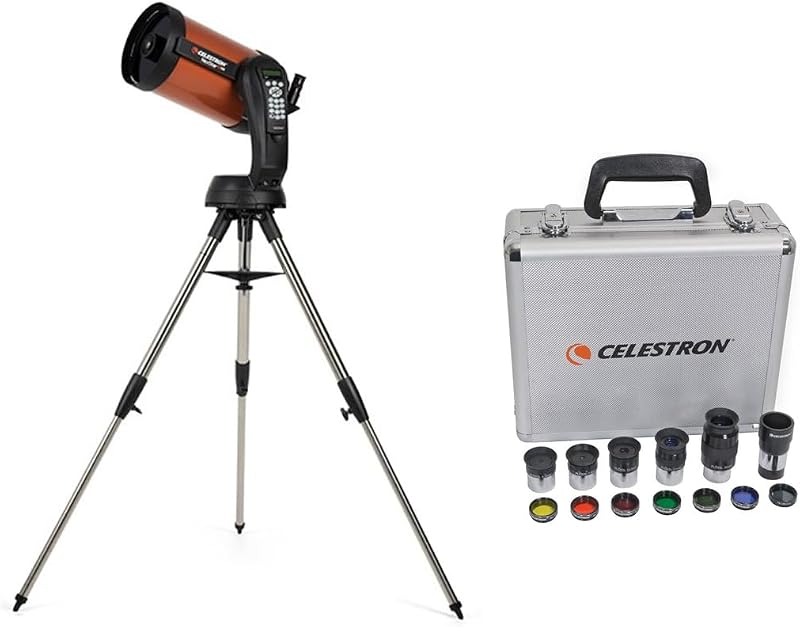
| Feature |
Best Overall
Celestron NexStar 8SE Computerized Telescope ...
|
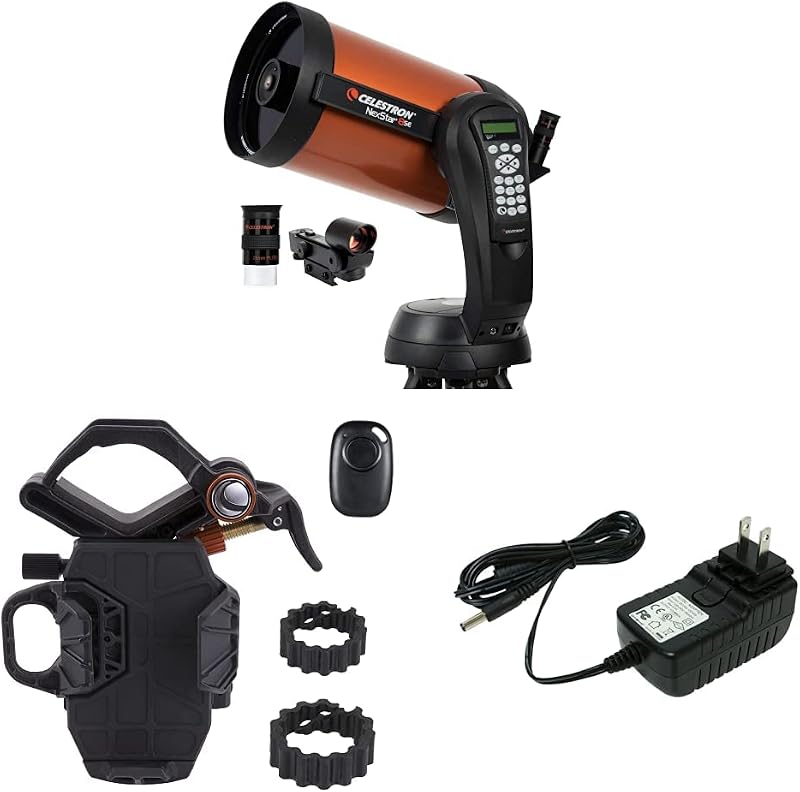 Celestron NexStar 8SE Telescope, 8-Inch + Nex...
|
Celestron NexStar 8 SE Schmidt-Cassegrain Tel...
|
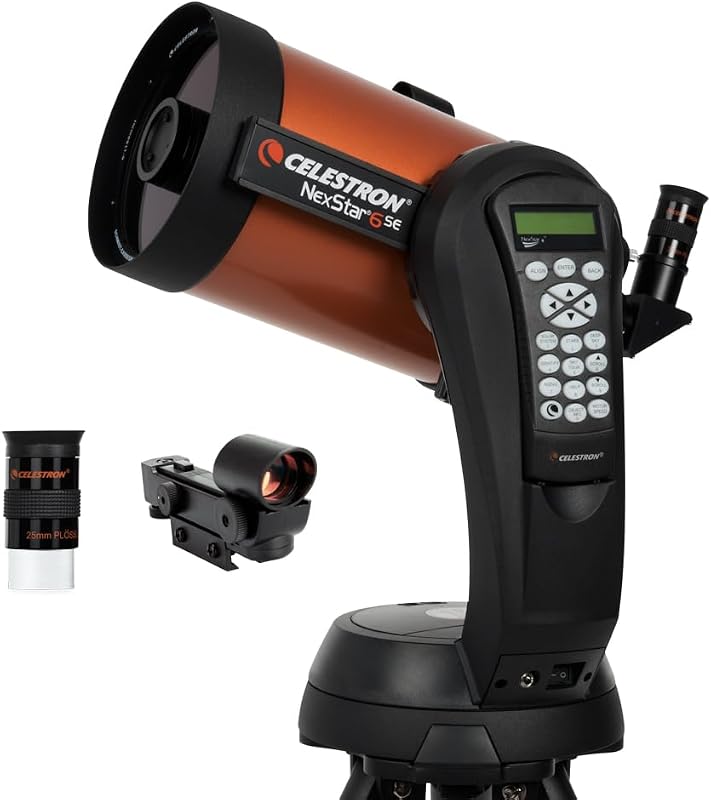 Celestron NexStar 6SE Computerized Telescope,...
|
|---|---|---|---|---|
| Brand | — | — | — | — |
| Rating | (1,551) | (44) | (89) | (966) |
| Prime | ||||
| Check Price | Check Price | Check Price | Check Price |
Before diving into analysis, here are the hard numbers Celestron publishes, plus a few that matter more than Celestron highlights:
- Optical design: Schmidt-Cassegrain (SCT)
- Aperture: 203 mm (8 inches)
- Focal length: 2,032 mm
- Focal ratio: f/10
- Optical tube length: ~432 mm (17 inches) — the SCT fold means it's remarkably compact
- Limiting stellar magnitude: ~14.0 visually
- Resolving power (Dawes limit): 0.57 arc-seconds
- Mount type: Single-arm alt-azimuth (computerized GoTo)
- Tracking motors: DC servo motors, both axes
- Hand controller: NexStar+ (40,000-object database)
- Power requirement: 12V DC, 1.5A (requires external power or 8×AA batteries)
- Telescope tube weight: ~5.4 kg (12 lbs)
- Total system weight (tripod + mount + OTA): ~15 kg (33 lbs)
- Included eyepiece: 25 mm Plössl (81× magnification)
- Star diagonal: 1.25-inch, included
- Dovetail/mounting standard: Celestron-proprietary single-arm saddle (accepts Vixen-style dovetail bars)
- Street price (2026): approximately $1,349–$1,499 USD depending on retailer
The f/10 focal ratio is the most consequential number on that list. It shapes everything: the eyepieces you need, the field of view you get, and whether astrophotography is practical without additional accessories.
Optical Performance: What 8 Inches of SCT Aperture Actually Gets You
Visual Planetary and Lunar Observing
The NexStar 8SE's 203 mm aperture with a 2,032 mm focal length is ideally configured for high-magnification, high-contrast planetary and lunar work. At the included 25 mm Plössl you get 81× — a comfortable starting point. Swap in a quality 9 mm eyepiece (Celestron X-Cel LX or equivalent) and you're at 226×, which is where Saturn's Cassini Division snaps into clarity on a steady night. Push to a 6 mm eyepiece (339×) and on above-average seeing nights you'll resolve cloud belt detail on Jupiter, the polar cap on Mars during opposition, and fine rilles on the Moon.
Practically speaking, the atmosphere limits useful magnification to roughly 300–350× most nights at mid-latitude suburban sites. The 8SE's 0.57 arc-second resolution is often atmosphere-limited before it's aperture-limited — which is exactly what you want from a telescope in this class.
Deep-Sky Visual Performance
Here the f/10 focal ratio creates a genuine tradeoff. The long focal length produces a narrow true field of view — at the included 25 mm Plössl, you get roughly 0.6° of true field. Large open clusters like the Pleiades (M45, spanning ~2°) will feel cramped. The Andromeda Galaxy's full extent won't fit in the same view. However, for compact deep-sky objects — globular clusters like M13 (Hercules Cluster, 20 arc-minutes apparent diameter), planetary nebulae like the Ring Nebula (M57, ~1 arc-minute), and the cores of galaxies — the long focal length is an asset, not a liability. At 226× the Ring Nebula shows clear structure; M13 resolves to individual stars across its core.
The SCT design's light throughput is slightly reduced by the central obstruction (roughly 34% by diameter), which reduces contrast compared to a comparably-sized refractor or low-obstruction Newtonian. In practice this matters most for subtle extended-object contrast (nebula wisps, faint galaxy arms) but is largely invisible on point sources like stars.
Collimation and Thermal Acclimation
Two practical optical realities SCT owners must manage: collimation and cool-down time. The NexStar 8SE's collimation is adjusted via three Bob's Knobs-style (or standard Phillips-head) screws on the secondary mirror. It holds collimation well once set, but if you transport it frequently, check it. Cool-down from room temperature takes 30–45 minutes for the tube to thermally equilibrate with outdoor air — plan your observing sessions accordingly. Rushing this produces blurry, shimmering star images that beginners often misattribute to poor seeing or bad collimation.
The NexStar+ GoTo Mount: Real-World Accuracy and Tracking
Alignment and GoTo Performance
The single-arm alt-azimuth mount uses a 2-star or SkyAlign (3-star) alignment routine. SkyAlign is genuinely beginner-friendly — you point at any three bright objects you can identify (even without knowing their names) and the hand controller calculates its orientation. After a good 3-star alignment, GoTo accuracy is typically within 0.5°–1° for objects across the sky, meaning most objects land within the field of a 25 mm Plössl. For objects near the horizon or near the zenith, accuracy degrades slightly.
The 40,000-object NexStar+ database covers the Messier catalog (110 objects), NGC catalog, IC catalog, and a useful set of double stars and asteroids. In 2026 the NexStar+ hand controller is also compatible with Celestron's StarSense AutoAlign accessory ($199 separately), which uses a camera to align the mount automatically in under 3 minutes — a worthwhile upgrade for observers who find manual alignment tedious.
Tracking for Visual vs. Astrophotography Use
The alt-azimuth mount tracks in both axes simultaneously to follow objects as the Earth rotates. For visual observing this works excellently — at 200× an object will stay centered for several minutes. For astrophotography, the alt-az mount introduces field rotation: the image slowly rotates around the center of the field as the Earth turns. This limits unguided exposure times to roughly 30–60 seconds before field rotation blurs extended objects. For planetary imaging (high frame rate video stacking with a dedicated planetary camera like a ZWO ASI224MC), field rotation is a non-issue — exposures are milliseconds long. For deep-sky astrophotography requiring multi-minute subs, you need a wedge.
Celestron's Wedge for NexStar 8SE ($249–$299) converts the mount to equatorial operation, eliminating field rotation and enabling guided long-exposure imaging. Without it, deep-sky astrophotography is severely constrained.
Setup, Portability, and Build Quality
Assembly and Setup Time
The NexStar 8SE's single-fork arm and collapsible stainless steel tripod assemble in about 10–15 minutes once you've done it a few times. The tube slides onto the arm via a Vixen-style dovetail saddle and locks with a hand knob. The tripod spreader doubles as an accessory tray. There's no counterweight shaft or secondary mirror assembly to worry about, unlike an equatorial-mount Newtonian.
The single-arm design is a legitimate portability advantage over the NexStar 8SE's main rival categories — it fits in a mid-size SUV trunk without disassembly. The tube alone (5.4 kg / 12 lbs) is backpack-portable if you have a dedicated carrying case, though the full system with tripod is a two-trip car-to-field carry.
Build Quality Assessment
The optical tube uses a cast aluminum cell with Celestron's StarBright XLT coatings (broadband anti-reflection coatings on the corrector plate lens, multi-layer coatings on the mirrors). The mechanical focuser is a rear-cell push-pull knob that moves the primary mirror — it has some mirror shift (image movement during focusing), which matters for astrophotography. An aftermarket Celestron Focuser Lock or JMI motorized focuser eliminates this. The hand controller cable is a 8-pin modular plug; carry a spare because it's a known failure point on well-traveled units.
NexStar 8SE vs. the Competition: Structured Comparison
The $1,200–$1,800 telescope market contains several genuine alternatives. Here's how they compare on the criteria that matter for the NexStar 8SE's target audience:
| Telescope | Aperture | Focal Length / Ratio | Mount Type | GoTo Database | Best Use Case | 2026 Street Price |
|---|---|---|---|---|---|---|
| Celestron NexStar 8SE | 203 mm (8") | 2032 mm / f10 | Single-arm Alt-Az GoTo | 40,000 objects | Planetary, lunar, compact DSOs; visual + limited AP | ~$1,399 |
| Celestron NexStar 6SE | 150 mm (6") | 1500 mm / f10 | Single-arm Alt-Az GoTo | 40,000 objects | Entry SCT; more portable, less aperture | ~$849 |
| Celestron NexStar Evolution 8 | 203 mm (8") | 2032 mm / f10 | Single-arm Alt-Az GoTo (WiFi) | 40,000 objects | Same optics as 8SE; adds built-in WiFi & internal battery | ~$1,799 |
| Sky-Watcher 8" Dobsonian (non-GoTo) | 203 mm (8") | 1200 mm / f5.9 | Manual Dobsonian | None | Visual deep-sky; maximum aperture per dollar, no tracking | ~$499 |
| Sky-Watcher Virtuoso GTi 150P | 150 mm (6") | 750 mm / f5 | GoTo Alt-Az tabletop | SynScan, 42,000+ objects | Compact, budget GoTo; less aperture and focal length | ~$599 |
| Meade LX90 8" ACF | 203 mm (8") | 2032 mm / f10 | Dual-arm Alt-Az GoTo | 30,000+ objects | Similar to 8SE; dual-arm more rigid, ACF optics reduce coma | ~$1,599 |
NexStar 8SE vs. NexStar Evolution 8: Is the Upgrade Worth $400?
The Evolution 8 uses identical optics and the same fork mount geometry but adds built-in WiFi (control with your phone via SkySafari or Celestron's app), a rechargeable internal lithium battery (good for ~10 hours per charge), and a slightly more refined mount. If you observe at a dark site without AC power and hate cable management, the Evolution 8's internal battery is genuinely useful. For most urban/suburban observers with a standard 12V power tank, the 8SE at $400 less is the smarter choice.
NexStar 8SE vs. Sky-Watcher 8" Dobsonian: When Aperture-per-Dollar Wins
The $499 Sky-Watcher 8" Dobsonian gives you identical aperture, a faster f/5.9 focal ratio (wider fields of view, better for large deep-sky objects), and dramatically simpler mechanics. What you lose is GoTo, tracking, and the ability to find faint objects without learning to star-hop. If you're willing to learn traditional star-hopping and you prioritize deep-sky visual observing over planetary detail, the Dob is a legitimate choice. If finding objects is a barrier — or if you want to show guests a live-tracked planet — the 8SE's GoTo is transformative.
Astrophotography with the NexStar 8SE: Honest Assessment
The NexStar 8SE occupies a specific astrophotography niche: it is excellent for planetary and lunar imaging, capable-but-limited for deep-sky without accessories, and practical for deep-sky with the wedge upgrade.
Planetary Imaging
For planets, the 2,032 mm focal length and 203 mm aperture are near-ideal for capturing Jupiter, Saturn, and Mars at high resolution. A ZWO ASI224MC ($229) or ASI585MC ($299) planetary camera paired with the NexStar 8SE captures video at 100–200 frames per second; stack 3,000–5,000 best frames using AutoStakkert! and process in Registax 6 to produce stunning planetary detail. The alt-az tracking is more than sufficient for planetary work. Many observers also add a 2× Barlow (Celestron Ultima or TeleVue Powermate) to bring the effective focal length to 4,064 mm, squeezing more planetary disk scale onto the sensor.
Deep-Sky Imaging
Without the equatorial wedge: limited to very short exposures (≤60 seconds) before field rotation becomes visible. The f/10 focal ratio also means longer total integration time is needed to get well-exposed nebula images vs. a faster f/5 or f/6 system. Using a focal reducer/field flattener (Celestron's 0.63× reducer brings the 8SE to f/6.3 and 1,280 mm focal length) helps both problems — wider field, 37% less required exposure time. With the wedge and a guiding setup (ASI120MM mini-guide camera + PHD2 software), the NexStar 8SE can produce respectable galaxy and globular cluster images where that long focal length becomes an asset.
Essential Accessories to Buy With the NexStar 8SE
The included accessories (25 mm Plössl + 1.25" diagonal) are functional but undersupply a capable 8-inch telescope. Here's what actually improves the experience:
- Power supply: Celestron PowerTank Lithium Pro ($130) or any regulated 12V / 5A DC source. The 8×AA option burns batteries fast. Non-negotiable for field use.
- Additional eyepieces: A 9 mm wide-field (Celestron X-Cel LX 9mm, ~$60) for 226× planetary and a 32 mm for wider fields. The 25 mm Plössl is adequate but a 2" 30mm eyepiece (requiring a 2" diagonal upgrade) gives a noticeably wider true field.
- Dew shield: Celestron 8SE dew shield ($29) or flexible neoprene wrap. The SCT corrector plate dews up fast on humid nights, ruining views. A dew heater strip ($25–$40) is the more complete solution.
- Barlow lens: Celestron Ultima 2× ($45) or TeleVue 2× Powermate ($175) for planetary magnification.
- Bob's Knobs (collimation thumbscrews): $29 — makes collimation tool-free and practical in the dark.
- StarSense AutoAlign: $199 — adds automatic alignment in under 3 minutes if the 2-star/SkyAlign routine frustrates you.
Who Should Buy the NexStar 8SE in 2026?
The NexStar 8SE is the right telescope if you:
- Have outgrown a 70–80 mm refractor or a small Newtonian and want a serious step up in aperture and capability
- Prioritize planetary and lunar detail, or close-up views of compact deep-sky objects (globulars, planetary nebulae, galaxy cores)
- Want GoTo object-finding — either because you're still learning the sky or because you simply want to spend time observing rather than hunting
- Observe from a suburban or light-polluted site where the SCT's contrast on point-like objects compensates for limited dark-sky access
- Plan on casual or planetary astrophotography alongside visual use
Consider alternatives if you:
- Have a dedicated dark-sky site and primarily want to sweep large extended nebulae — the fast f/5–f/6 Dobsonian wins here
- Need a deep-sky imaging platform from day one — a dedicated EQ mount with a faster OTA (like the Sky-Watcher EvoStar 80ED on an HEQ5 Pro) is purpose-built for that workflow
- Have a tight $800 budget — the NexStar 6SE gives you the same GoTo experience at 150 mm aperture for $500 less
Frequently Asked Questions: NexStar 8SE
Does the NexStar 8SE need to be polar aligned?
No — for visual observing and planetary imaging, alt-azimuth alignment is all you need. The two-star or SkyAlign routine takes 5–10 minutes and requires no knowledge of Polaris or polar alignment. For long-exposure deep-sky astrophotography, you would need the optional equatorial wedge and then perform a rough polar alignment, but this is an optional upgrade scenario, not a default requirement.
How much does the NexStar 8SE weigh, and is it portable?
The optical tube weighs approximately 5.4 kg (12 lbs). The full system — tube, single-fork arm, and tripod — is roughly 15 kg (33 lbs) total. Most adults can carry it in two trips from car to observing site. The OTA's compact length (432 mm / 17 inches) fits in the rear of most sedans and SUVs without disassembly. It's not a "grab-and-go" telescope by backpack standards, but it's genuinely transportable compared to most 8-inch OTAs.
Can I use the NexStar 8SE for deep-sky astrophotography?
With limitations, yes. Without the equatorial wedge, you're limited to roughly 30–60 second unguided exposures before field rotation blurs extended objects — usable for very bright targets like M42 or M31's core, but inadequate for faint galaxies. Adding Celestron's wedge ($249–$299) and a guide camera/software setup (PHD2 + guide scope) opens up multi-minute guided exposures. The f/10 focal ratio also benefits from the 0.63× focal reducer, bringing it to f/6.3 and significantly improving image brightness and field of view for deep-sky work.
What is the difference between the NexStar 8SE and the NexStar Evolution 8?
The optics are identical — same 203 mm SCT tube, same 2,032 mm focal length, same f/10 ratio. The Evolution 8 ($1,799) adds built-in WiFi for smartphone/tablet control (compatible with SkySafari Pro), a built-in rechargeable lithium battery (no external power pack needed), and a slightly more refined mount body. The 8SE at ~$1,399 is the better value for most buyers; the Evolution 8 justifies its $400 premium mainly if you hate power cable management at dark sites.
What eyepieces work best with the NexStar 8SE?
The 2,032 mm focal length means eyepiece focal length directly determines magnification: divide 2,032 by eyepiece focal length. A 25 mm gives 81×, a 15 mm gives 135×, a 9 mm gives 226×, and a 6 mm gives 339×. For planetary observing, a quality 9–10 mm eyepiece (Celestron X-Cel LX, Baader Classic Ortho, or Explore Scientific 82° series) is the most-used focal length. Apparent field of view matters less at high magnification but more at low power — a wider-angle 32–35 mm eyepiece for the finder role is a good complement.
Is the NexStar 8SE good for viewing Saturn's rings?
Absolutely — this is one of the telescope's showcase uses. At 226× (9 mm eyepiece) Saturn's rings and the Cassini Division (a 4,800 km wide gap between the A and B rings) are clearly split on average seeing nights. The planet's banding, multiple moons (Titan at magnitude 8.5 is easy; Rhea, Tethys, and Dione are visible under good skies), and subtle polar hexagon shape are all accessible. On exceptional seeing nights at 300×+, the Crepe Ring (C ring) becomes visible against the planet's disk. The 8SE is genuinely one of the most capable instruments at this price point for Saturn specifically.
Conclusion: The NexStar 8SE Verdict for 2026
In 2026, the Celestron NexStar 8SE remains the most logical choice for the intermediate amateur astronomer who wants serious 8-inch aperture, GoTo convenience, and a compact SCT form factor in a single system under $1,500. Its 203 mm aperture and 2,032 mm focal length are near-perfect for planetary and lunar work, capable for compact deep-sky objects, and expandable toward astrophotography with the right accessories. The single-arm alt-azimuth mount is genuinely portable and the NexStar+ hand controller's 40,000-object database eliminates the learning curve of manual star-hopping.
Its real limitations — narrow field of view at f/10, the field rotation constraint on deep-sky imaging, and the 30–45 minute thermal acclimation requirement — are manageable realities rather than dealbreakers, provided you understand them before buying. The comparison table above shows the alternatives clearly: if your primary goal is maximum aperture per dollar for visual deep-sky work, a manual Dobsonian beats it on value; if you want integrated WiFi and battery, the Evolution 8 extends the same platform; if budget is tight, the 6SE offers the same experience at smaller scale.
For the observer who wants a reliable, capable, telescope that grows with them from visual planetary observing through casual astrophotography — and who values being able to point at 40,000 objects on command — the NexStar 8SE is still the telescope to beat at this price point.